What Is Menu Engineering? A Restaurant Guide to Profitable and Popular Menu Items
Menu engineering is a method for evaluating menu items by looking at popularity and contribution margin together, rather than using sales volume alone. The goal is not simply to identify the best seller, but to understand which items create value, which need more visibility, and which may require pricing, portion, or portfolio changes.
Why Does Menu Engineering Matter?
An item can sell frequently while contributing relatively little margin. Another item may provide a strong contribution margin but sell poorly because customers rarely notice it. Looking only at sales volume can hide this difference.
1. How Is Contribution Margin Calculated?
A simplified formula is:
Contribution Margin = Selling Price − Direct Item Cost
This is not the same as net profit, but it is a useful operational measure for comparing menu items.
2. How Is Popularity Measured?
Popularity can be evaluated by looking at an item's share of category or total menu sales during a defined period. The result should be considered together with contribution margin.
The Four Menu Engineering Categories
Star: High Popularity + High Contribution Margin
Stars sell well and provide a strong contribution. Their visibility and product consistency should generally be protected.
Plowhorse: High Popularity + Lower Contribution Margin
Plowhorses sell frequently but contribute less margin. Portion size, recipe cost, or pricing may deserve review.
Puzzle: Lower Popularity + High Contribution Margin
Puzzles can be financially attractive but underperform in sales. Product naming, descriptions, photography, placement, or staff recommendations may be tested.
Dog: Lower Popularity + Lower Contribution Margin
Dogs may need to be reconsidered in terms of menu space, inventory complexity, and operational value. Strategic items should not be removed automatically without context.
Example Menu Engineering Matrix
| Item | Sales Trend | Contribution | Class | Possible Action |
|---|---|---|---|---|
| Signature Burger | High | High | Star | Protect visibility |
| Classic Pasta | High | Low | Plowhorse | Review cost, portion, or price |
| Premium Steak | Low | High | Puzzle | Test presentation and visibility |
| Low-Selling Dessert | Low | Low | Dog | Review its role on the menu |
How Should Items Be Highlighted?
Highlighting is not only about large images. Category order, item order, concise labels, descriptions, and photography can all influence visibility.
For mobile usability, see our QR Menu UX Guide.
How Often Should Menu Engineering Be Performed?
There is no universal schedule. Businesses with frequent price or product changes may review monthly or by period, while more stable menus may use quarterly or seasonal analysis.
Is Raising the Price Always the Right Answer?
No. A low contribution margin can also be addressed by reviewing recipe cost, portion size, purchasing cost, and customer price sensitivity.
How Can a Digital Menu Support Menu Engineering?
A managed digital menu makes it easier to change item order, descriptions, photography, and visibility after analysis.
For platform capabilities, see What Is a Digital Menu System?.
What Is the Relationship Between QR Menus and Menu Engineering?
A QR menu is not menu engineering itself. It is the digital channel through which products are presented and changes can be applied. Menu engineering is the analysis used to decide what those changes should be.
For the wider QR menu topic, return to our complete QR Menu Guide.
6 Practical Steps for Menu Engineering
- Select the analysis period.
- Collect item sales volume.
- Calculate direct item cost.
- Compare contribution margins.
- Classify items by popularity and contribution.
- Test controlled changes to price, visibility, portion, or product portfolio.
Avoid Common Calculation Errors
At a selling price of TRY 320 and direct item cost of TRY 125, the simplified unit contribution is TRY 195. Twenty portions yield TRY 3,900 in contribution before rent, labor, taxes, and other costs. Set the comparison period and category before assigning popularity labels. Low volume alone does not justify removing a strategic item.
Applying menu-engineering decisions in QR AppMenu
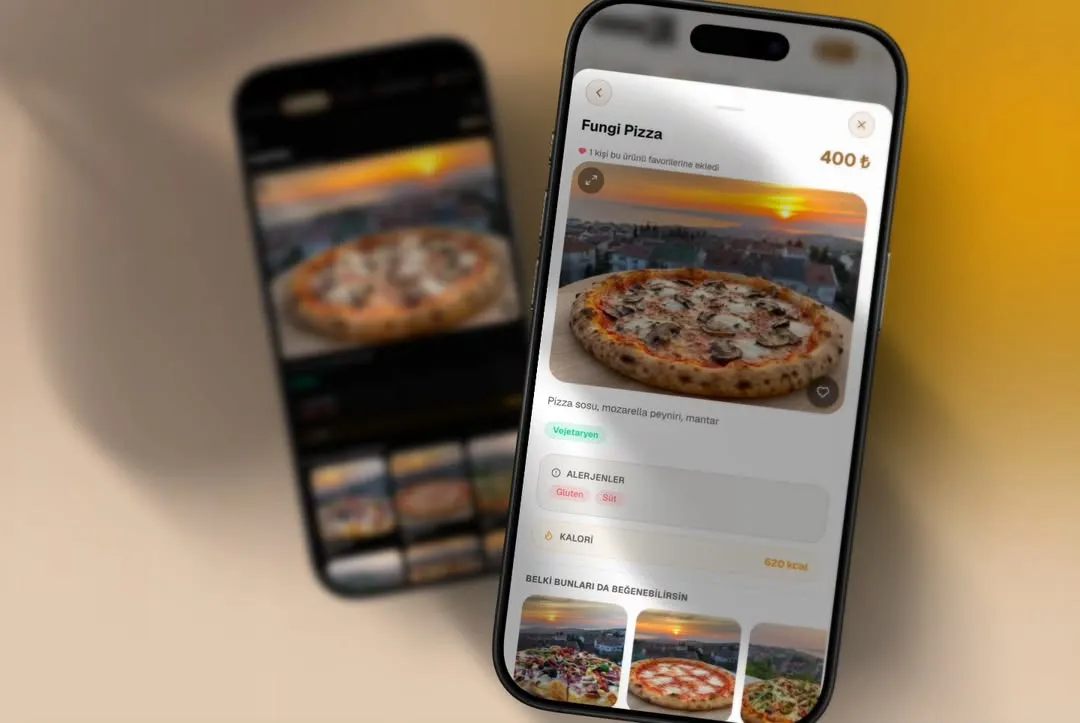
A high-contribution item with low sales might benefit from a clearer description, more representative photography, or different menu placement. QR AppMenu's gallery and item-management features can support presentation changes, but favorites and views do not prove a purchase. Actual unit sales and ingredient costs must come from reliable business records. Do not assume the product includes POS integration or advanced sales analytics.
Worked example: popularity and contribution are different measures
The figures below are fictional illustrations, not QR AppMenu customer results. Suppose product A sells 100 portions in a week at 200 TRY each, with a direct item cost of 140 TRY. Its unit contribution is 60 TRY and total contribution 6,000 TRY. Product B sells 40 portions at 300 TRY, with a direct cost of 100 TRY. Its unit contribution is 200 TRY and total contribution 8,000 TRY. A is more popular by units, but B contributes more in this simplified example.
| Item | Units | Unit contribution | Total contribution |
|---|---|---|---|
| A (example) | 100 | 60 TRY | 6,000 TRY |
| B (example) | 40 | 200 TRY | 8,000 TRY |
How to test a first change
Use trustworthy sales and recipe-cost records to select items. Change one presentation element at a time: for example, replace B's photo with a more representative image, or clarify its description. Follow comparable sales periods and seasonal effects. QR AppMenu can support menu-presentation changes, but should not be assumed to attribute a menu view to an actual sale automatically. Do not present a small short-term swing as proven uplift.
Conclusion
Menu engineering turns menu decisions into a process supported by sales and cost data. The best-selling item is not always the most valuable item, and a low-selling item is not automatically a failure.
Frequently Asked Questions
What is menu engineering?
How is contribution margin calculated?
What do Star, Plowhorse, Puzzle, and Dog mean?
Is the best-selling item always the most profitable?
How often should menu engineering be performed?
How can a QR menu support menu engineering?
Related Posts